
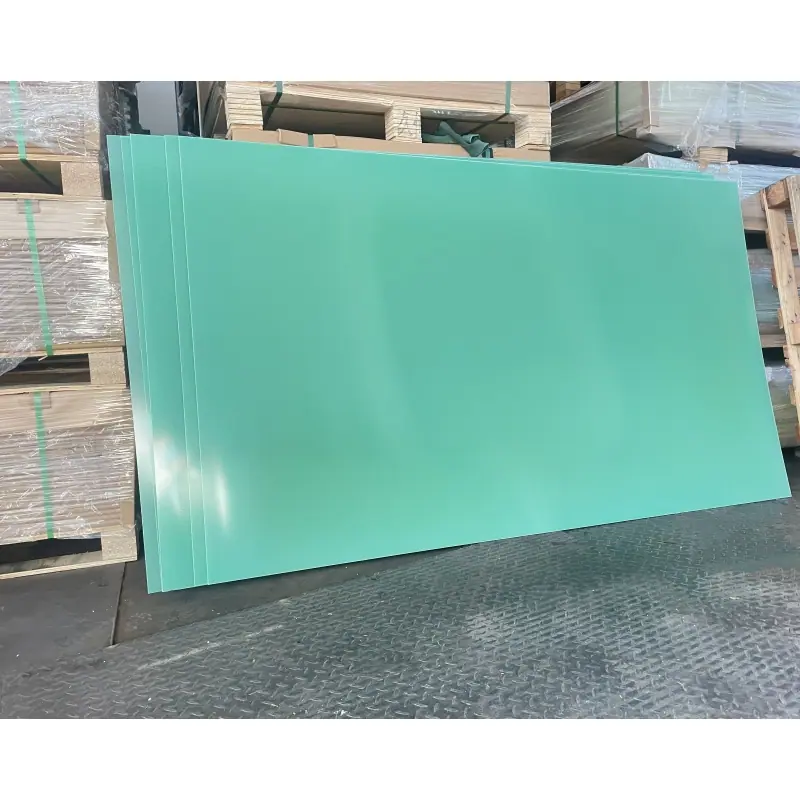
FR4 sheet represents one of the most popular engineering materials of insulation system today. It is essentially a fiberglass-reinforced epoxy laminate that is aimed at providing a reliable mixture of electrical insulation, mechanical strength, thermal and flame resistance. Although What is FR4 Sheet?FR4 was initially met by the majority of people in a printed circuit board, it has value much beyond electronics.
FR4 sheet is known to be a high performance insulation material in industrial applications as equipment, panels, structural supports as well as components in equipment where electrical stress, heat and mechanical load are involved.
It is significant because of balance. Other types of insulation are good at electric conductivity but weak. There are also those that are powerful yet not as dielectrically performance or thermal reliable. FR4 sheet occupies this niche through offering a rigid and tough material that is consistent in extreme conditions. This is the reason why it can be found in the power generation industry, heavy equipment, switchgear, transformers, motors and industrial fabrication.
The other reason why FR4 sheet is not becoming irrelevant is that it is versatile. It is capable of being cut, drilled, machined and fabricated into custom parts in use. It can also be made in various grades to meet the needs of the high temperatures, strict environmental standards, or special safety standards.
This article discusses FR4 sheet in terms of insulation and engineering. Instead of concentrating primarily on its application in circuit boards, it looks at the definition of FR4 sheet, its manufacture, explanation of its importance in terms of properties and its use as a support material in industrial insulation solutions.
What is FR4 Sheet?
FR4 is an abbreviation of Flame Retardant Grade 4. It can be described as a category of fiberglass-reinforced epoxy laminate substances, which are intended to provide high electrical insulation as well as dependable structural behaviour. One of its characteristics including flame retardancy is brought out in the name itself. This is why FR4 sheet is particularly beneficial in the areas where it is necessary to consider the safety, fire resistance, and stability of the material.
The fabric is produced by blending woven fiberglass cloth and epoxy resin bond. The strength, rigidity, and dimensional stability of the sheet are provided by the fiberglass, whereas the bonding matrix is the epoxy resin and offers outstanding insulating qualities. After being laminated and cured, the outcome is a hard and durable sheet that can be employed in electrical as well as mechanical works.
One of the major features of FR4 sheet is that it is not flexible but is hard. This renders it appropriate to machined insulation components, support structures, barriers and panels that need to resist their shape when subjected to load and long term service. It is also said to be resistant to electrical leakage, moderate to high temperature, and performance in humid or chemically contaminated environments.
Whereas FR4 is normally associated with PCB production, reducing it to that is not indicative of its industrial potential. In most engineering industries, FR4 sheet is not selected as circuitry but as insulation. It finds extensive application in most places where non-conductive, mechanically strong as well as flame retardant material is needed. It is that extended use in insulation systems where FR4 sheet is such an important engineering material.
Structure and Composition of FR4 Epoxy Sheet
The composition and layered structure are the direct results and causes of the FR4 sheet to perform. It is not a smooth sheet of plastic or a plain board made of fiberglass. It is a highly designed composite where every constituent leads to the overall balance of electrical, thermal and mechanical characteristics.
A. Fiberglass Reinforcement
FR4 sheet is a woven fiberglass cloth, which is its reinforcing phase. This is a fiberglass which is used as the backbone of this material. It makes the sheet extremely strong in tensile strength, good flexural performance, rigidity and dimensional stability. The fiberglass is hard and does not deform easily, therefore, it is used to ensure that FR4 does not change its shape during mechanical forces or variations of the environmental conditions.
The fabric of the cloth is also woven, which is also a contribution to stability in several directions. This is relevant in circumstances when the sheet can undergo drilling, cutting, fastening, vibration or load on its structure. The material would not be as strong or durable without being reinforced with fiberglass.
B. Epoxy Resin System
Epoxy resin is the adhesive block that glues the layers of fiberglass. It is poured in between the weaved strands, solidifies into a hard compound, and forms the insulating body of the laminate that is in a continuous form. The reason behind the use of epoxy resin is that it offers high adhesion, electrical insulation, chemical resistance and acceptable thermal conductivity.
The resin is not glue only in FR4 sheet. It is a significant component of the dielectric characteristics and resistance to the environment of the material. It holds the fiberglass together, shields it as well as provides the laminate with a uniform solid framework.
C. Laminate Structure
FR4 sheet is a multi-laminate. The several sheets of fiberglass impregnated with resin are piled and bonded under pressure and heat. This multi-layered construction enhances strength, thickness regulation as well as long-term durability. It also enables the manufacturer to make sheets of varying thickness based on the use.
D. Variants of FR4 Sheet
FR4 comes in a number of forms. General industrial use of epoxy sheet is standard FR4. High Tg variants are developed with a higher performance at a higher temperature. Where the environmental or regulatory requirements are more stringent, then there are halogen-free and environmentally conscious grades. These versions make it possible to use FR4 sheet to meet many contemporary insulation requirements.
Manufacturing Process of FR4 Sheet
FR4 sheet manufacturing process is fabricated so as to create a rigid and uniform laminate that has good insulating and structural qualities which are reliable. Each of the stages is important since the final performance is based on the quality of the reinforcement, resin system, lamination conditions, and finishing work.
It starts by preparing woven fiberglass fabric. The fiberglass cloth should be clean, uniform and well shaped, so as to have uniform reinforcement all over the laminate. The material is chosen based on the type of thickness, strength, and the level of performance of the finished FR4 sheet.
This is followed by resin impregnation. An epoxy resin system is impregnated on the fiberglass fabric. This is necessary as the resin should enter the cloth correctly and coated on the fibers evenly. In case of poor impregnation, the sheet may experience poor bonding, voids or poor electrical operation. Once impregnated, the substance is usually partially dried or pre-treated into a prepreg step, in which it is both tacky enough to be overlaid with, but stable enough to be handled.
Prepreg layers are then overlaid to the required stack sequence to provide the required thickness of the sheet and performance. After laying them, the layers are loaded into a lamination press. The heat and pressure are applied in such a manner that the epoxy flows and laminates the layers and forms a thick laminate. The stage provides FR4 sheet with its tight form and mechanical strength.
Curing of the sheet takes place after the lamination. The epoxy resin undergoes a process of chemical cross-linking in the course of curing and hardens into a rigid and long-lasting matrix. It is what provides FR4 with its ultimate stiffness and stability.
The healed sheets are cut, trimmed and made to regular sizes or special sizes. The inspection is done on the surface quality, thickness tolerance, and internal consistency. The sheets are also subjected to manufacturers to flame-retardant and material performance tests in order to verify its adherence to the necessary ratings and certifications. The outcome is a complete FR4 sheet that can be fabricated into insulation material.
Key Properties of FR4 Sheet as an Insulation Material
The FR4 sheet is considered to be of value in industrial insulation since it integrates many properties that are essential in a single material.
A. Electrical Insulation Properties
Among the reasons why FR4 sheet is important is that it has a high electrical insulation ability. It has a great dielectric strength, that is, it is capable of experiencing a large amount of electrical stress without disintegrating. This is appropriate in barriers, supports, slot insulation parts and components that are installed close to live electrical systems.
FR4 is also low-electrical conductivity. In a practical sense, it opposes a flow of current and assists in separating conductive components of objects. This is very vital in systems where both performance and safety require electrical separation.
B. Thermal Properties
FR4 sheet is also a heat resistant material in comparison to most of the common insulation materials. It is stronger than low grade laminates and plastics, it can withstand high service temperature, has better structural integrity and it can service the temperature.
The glass transition temperature or Tg is one such thermal property. This is the temperature level in which the resin system starts to soften and lose certain rigidity. Better thermal stability is required and so high Tg FR4 grades are chosen.
C. Mechanical Properties
FR4 sheet is dimetallically strong, hard and dimensionally stable. It is good in tensile and flexural strength which enables it to hold the load without cracking or deforming easily. It is also harder to be knocked against than brittle insulation materials like ceramics.
It is particularly rigid and is particularly applicable in structural insulation components. FR4 can be used as supports, spacers, barriers, or panels and does not lose its alignment and shape under the working stress.
D. Chemical and Environment Resistance
FR4 sheet is very resistant to moisture and humidity and this is very vital in determining the reliability of insulation in the long term. Some types of insulating materials may have their performance worsened by moisture, but FR4 normally can withstand the damp or varying conditions.
It is also resistant to lots of chemicals, oils and solvents. This ensures that it can be used in industrial environments where there is likelihood of coming in contact with lubricants, cleaning chemicals or process fluids.
E. Fire Retardant Properties
FR4, as the name implies, is flame retardant. It is constructed to resist ignition and in case it comes into contact with fire, it should extinguish itself instead of easily burn. This brings a significant level of protection to electrical and industrial systems. Where there is the possibility of overheating or sparks, or fault conditions, flame-retardant insulation materials will be a significant advantage.
Industrial Applications of FR4 Sheet
The actual power of FR4 sheet is apparent in its industrial uses. It has a common usage in electronics, but its extended use has been seen in insulation systems in the power, manufacturing, thermal equipment, and heavy industry.
A. Electrical Insulation Systems
FR4 sheet is used more commonly in an electrical insulation system. It is applied in the insulating of panels in switchgear, distribution board, and control panel. The material used in these assemblies will assist in the separation of live conductors, security of the surrounding structures, and also minimize the chances of electrical faults.
FR4 is also applied in transformer insulation elements and dielectric dependability and dimensional stability are crucial. It may be made in non-conductive structural elements (slot wedges, insulation supports etc.) in motors. In most of these applications, it is better than soft or weaker materials due to its strength and insulation.
B. Mechanical and Structural Insulation
Strong yet non-conductive materials are required in most machines in industries. FR4 sheet can be utilized in support structures, mounting plates and spacers, barriers where electrical isolation is required, and rigidity has to be compromised. This is especially useful in the systems that mix electrical and mechanical loads.
Heavy machinery might also need insulating barriers between metal components, energized areas, or hot areas. FR4 is a reliable choice since it does not deform easily and does not lose its characteristics even under severe service conditions.
C. Thermal Insulation Applications
FR4 sheet can also be utilized in thermal insulation processes in which moderate and high heat resistance is required. It may be used as a heat shield, high temperature panel or even an insulating barrier in equipment that is to be exposed on high temperatures.
It can be used in furnaces, in industrial heating systems and in thermal process equipment where a rigid insulating sheet is required but a ceramic material would be prohibitively expensive or too brittle to do the task.
D. Industrial Equipment and Manufacture
FR4 sheet is often CNC machined into individual insulation. These can be in the form of brackets, washers, spacers, terminal boards, guide plates and structural inserts. Its machinability is good, and therefore, it is applicable in custom engineering and OEM production.
FR4 sheet is used as the fabricated components of industries like oil and gas, power generation, rail, heavy manufacturing and process plants; where the components are required to resist electricity and stress, moisture and wear. One of the most obvious indications that FR4 is much more than a PCB material is this wide range of industrial applications.
E. Uses in Electronics
FR4 is of course still important in electronics, particularly as the substrate of printed circuit boards. Nevertheless, the PCB use, in this article, is not the whole picture. Its larger engineering narrative is that it is a rugged and dependable insulation material in a variety of industries.
The FR4 Sheet Insulation Advantages
FR4 sheet has a number of obvious benefits in the area of insulation, this is why it has remained a desirable material in the industrial world.
First, it has a good electrical insulation. It is characterized by high dielectric strength and low conductivity which makes it fit the tough electrical conditions where safety and reliability are paramount. This by itself renders it with great value in switchgear, and motors, transformers as well as insulated structural collections.
Second, FR4 is far superior in mechanical strength in comparison to other insulation materials. There are insulating materials which are effective electrically, but which are weak, soft, or brittle to be of structural service. FR4 is the solution to this issue as it offers rigidity, flexural strength, and impact resistance to the same material. This enables it to be a passive insulator, or working component of the assembly.
Third, its resistance to retardant proves to be safer. In industry, materials are usually required to operate in both faulty and normal conditions. The self-extinguishing property of FR4 also renders it a less risky option into non-flame-retardant laminates in a great number of situations.
The other significant benefit is that it is not hydrated and can withstand extreme weather. FR4 will withstand humidity, oils and most chemicals unlike simple insulation boards. This helps to extend the service and maintenance issues.
Another reason why engineers prefer FR4 sheet is because of long-term reliability. When it is used well within its design, it gives consistent performance with long durations of use.
Lastly, FR4 is relatively inexpensive as compared to certain more sophisticated composite materials or expensive ceramic thermal resistant materials. It is certainly not as extreme temperature as ceramics, yet, over a broad set of industrial uses, gives a very good price to performance to machinability to durability ratio.
Limitations and Objections
FR4 sheet does not have its limitations despite its numerous benefits. Its rigidity is among the key considerations. This is a plus on structural insulation, but it also implies that FR4 does not have much flexibility. It is not the proper option when bending or forming and bending or making repeated curves is necessary.
The other weakness is temperature performance. FR4 is an excellent thermal resistant material, although it does have a realistic maximum. At temperatures outside the range of temperatures in which the material can be used, both mechanical and insulating performance may decrease. Other materials like ceramics or special composites might prove to be more appropriate where the highest temperature is required.
Machining is another factor. FR4 is cut, drilled and CNC machined, but it is abrasive due to the fiberglass content. This implies that appropriate tools are necessary and the wear of tools can be high with time.
Also, the disposal and end-of-life aspects of disposal are also an environmental issue. FR4 is a thermoset composite, and therefore, not as simple to recycle as other materials. In the selection of material in the modern industrial systems, engineers and buyers are increasingly concerned about this.
FR4 Sheet vs Other Insulation Materials
FR4 sheet is often compared with other insulation materials, and these comparisons help explain where it fits best.
| Comparison | FR4 Sheet | Other Material | Key Difference |
| FR4 vs G10 | Flame-retardant fiberglass epoxy laminate | Similar laminate, usually not equally flame-retardant | FR4 is better where fire safety matters |
| FR4 vs Phenolic Laminates | Stronger, more stable, better heat resistance | Lower cost, suitable for lighter-duty uses | FR4 performs better in tougher environments |
| FR4 vs Ceramic Insulators | Good insulation with moderate to high heat resistance | Handles much higher heat, but is brittle and costly | FR4 offers a better cost-performance balance in many industrial uses |
| FR4 vs Plain Fiberglass | Epoxy-bonded laminate with strong insulation and rigidity | Reinforcement only, with less integrated performance | FR4 is more durable and electrically reliable |
| Machining | Can be cut, drilled, milled, and CNC machined | Varies by material | FR4 is highly machinable but abrasive, so carbide tools and dust control are needed |
Maintenance and Handling
FR4 sheet is not very demanding in terms of maintenance, although proper usage can maintain its performance. It must be kept in a dry environment without being in contact with unnecessary moisture exposure, in particular, prior to fabrication or installation. Although it is very resistant to the humidity, it is always good to store it properly.
Mechanical damage should also be maintained. Edges can be chipped or surfaces broken through sharp collisions, poor stacking or bad handling. Whenever cleaning, light processes need to be applied in order to prevent surface erosion or pollution. FR4 components can be used in the long term and be very reliable in industrial applications with sensible storage and care.
Future FR4 Insulation Material
It can be considered that the future of FR4 sheet will be characterized by the improvement of its performance and environmental optimization. Manufacturers are in the process of coming up with superior epoxy laminates of higher performance in thermal stability and consistency to meet the challenging industrial needs.
FR4 versions with lower levels of halogen and greater environmental friendliness are also gaining significance with increased environmental requirements. Simultaneously, the increasing pressure in the renewable energy sector, in the power infrastructure, in the electric systems, and in the heavy industry is most likely to continue making FR4 relevant.
Strength, flame resistance and machinability combine into one material will continue to be used as the need of insulation grows more and more intricate.
Bottom Line
FR4 sheet is much more than PCB base material. It is an efficient and reliable insulation material, which incorporates fiberglass reinforcement and epoxy resin insulation as well as flame resistance and high mechanical performance in a single rigid laminate.
Balance is an asset in its application in industry engineering. It is electrically insulating, reasonably heat-resistant, structurally performing and can survive numerous real life environmental situations. This renders it relevant in switchgear, transformers, motors, machinery, heat shielding, and machined industrial components of custom machining.
FR4 sheet is still a choice among engineers and manufacturers who need a material that is safe, durable, reliable, and practical. Its use in the non-electronic context is important and in the insulated contemporary use, it still remains a performance and protection backbone.
𝙁𝙤𝙧 𝙢𝙤𝙧𝙚 𝙞𝙣𝙛𝙤𝙧𝙢𝙖𝙩𝙞𝙤𝙣
📧Email:info@differentplastic.com


