
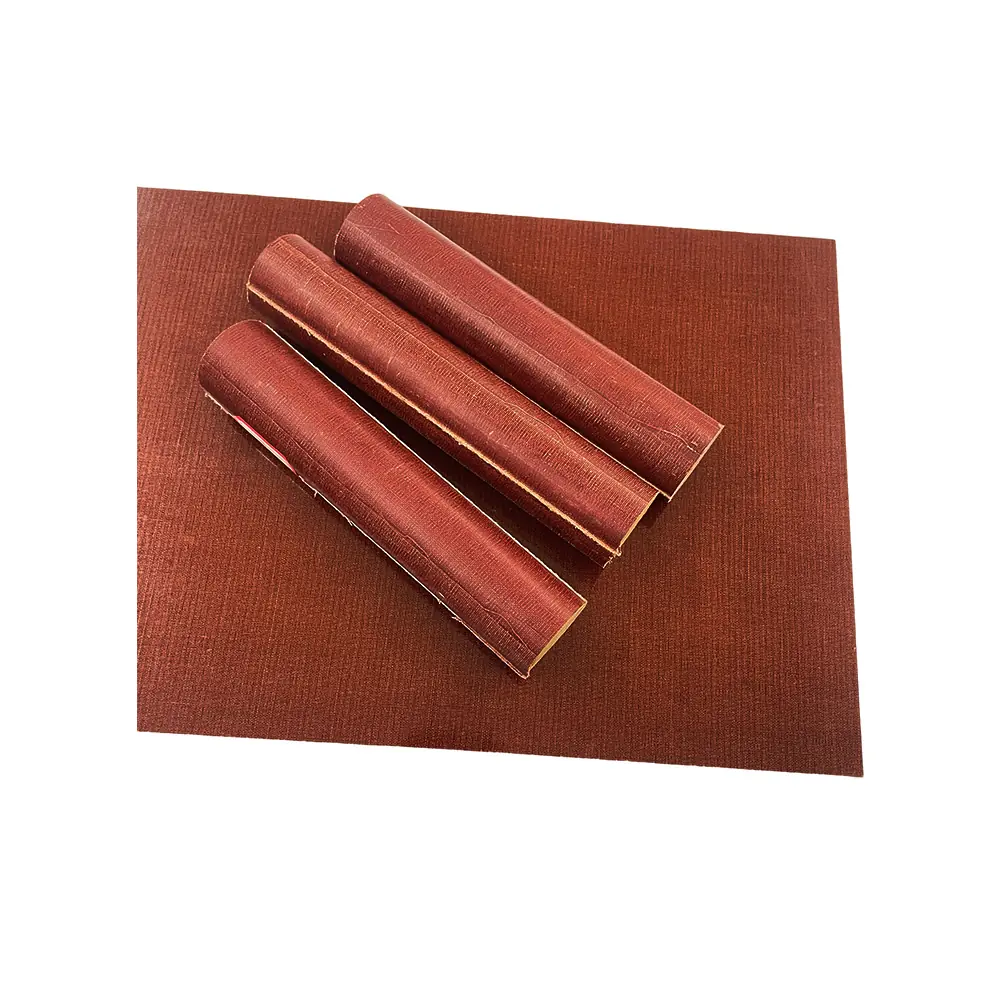
Textolite is a thermoset laminate reinforced with fabric. Produced by mixing layers of woven fabric with a resin system under heat and pressure. The end product is a sturdier industrial material that is strong and stable.
Unlike standard plastics, this material is not. Thermoplastics become soft at a moderate temperature. Most of them are not straight when under load. However, Textolite will not do this when fully cured. It has an internal structure that is fixed.
It is sometimes said that Textolite is similar to Bakelite. Both are in the thermoset material group. They are both hard and heat resistant. It is simply a matter of reinforcement. Bakelite is prone to cracking when under pressure. The layers of fabric within the resin are what Textolite uses. This renders it more tough and resistant to wear.
It’s also distinctive from rubber materials. Rubber is bendable and stretches. It’s meant to absorb movement. Textolite is not bendable. It is designed to provide structural support as well as electrical insulation.
Textolite is in a different class than engineering thermoplastics. Thermoplastics can be remolded when heated. Once textolite has cured it cannot be remelted. This increases its stability for long-term industrial applications, in which shape retention is crucial.
Textolite is still used by engineers in many applications. When mechanical strength and electrical insulation are necessary, it is used for this purpose. It is also selected for systems in which the presence of the oil, friction, and continuous load are found.
Not a new resource. A wide variety of uses for many years in the electrical and mechanical field. But it is still applicable. The answer is very easy. It works reliably in applications where many of today’s plastics would fail or be too brittle.
Textolite is a sensible compromise. It is not the most cutting edge material. Not to mention it is not the most efficient either. However, it will provide a combination of strength, insulation, and durability that can be used in the real industrial environment.
Key Highlights:
- Textolite is a laminate of thermoset resin reinforced with fabric, and has excellent mechanical stability.
- Provides electrical insulation and useful structural strength in industrial systems.
- Good wear, friction and machine environment characteristics in oil.
- Can be easily machined into sheet, rod, bushes and custom parts.
- It is best used in dry and moderate environments, not in hot, or wet systems.
Why Engineers Choose Textolite Instead of Plain Plastic?
Engineers don’t randomly select materials! Because in real life something keeps breaking, they pick them. Where plain plastic fails too soon, Textolite does not.
Unlike thermoplastics it does not soften. It is also not as brittle as many mechanical applications’ plastics. Its stability is the primary factor as to why it’s still in use.
1) Stable performance under mechanical stress
Under load, Textolite retains its shape. It does not bend or bend easily when pressure is applied. Normal plastics tend to creep over time. They slowly bend. Despite not being necessarily heavy loads. This movement is deterred by Textolite. Stress is reduced by the inner layers of fabric. This ensures its stability for a longer service life.
2) Better wear behavior than many low-cost plastics
A large number of low cost plastics are not wear resistant. Undergo rapid wear in mechanical action. Under sliding and contact conditions, Textolite is more effective. Resists erosion at different rates. This is helpful for parts like guides, supports. These parts are in motion and are subjected to friction every day.
3) Electrical insulation of structural strength
There are a number of insulators with low mechanical strength. They are good insulators and weak when put under pressure. Textolite does both jobs in one. Electrically insulates and resists mechanical force. This combination is applied in electrical panel and equipment frames. Eliminates the need to add insulating and supporting parts.
4) Resistance to oil, grease, and industrial fluids
Industrial areas aren’t clean. Oil and grease are present in all machines. There are many plastics that absorb or break down in these conditions. They get soft, or slippery in an undesirable manner. Textolite is more resistant to these fluids. It can stand its shape in oily areas. This increases its reliability in the workshop and factory.
5) Good machinability for custom components
Standard manufacturing is not always standard. There are many parts that require cutting, drilling and shaping. Common tools can be used to machine Textolite. In most cases special processing methods are not necessary. Mouldable to make precise parts like washers, spacers and supports. With this flexibility, engineers cannot redesign entire systems.
6) Long working life in dry and semi-harsh environments
Textolite is best suited to stable industrial environment. Not designed for harsh chemical or wet conditions. It is very durable in dry and moderately severe conditions. Does not deteriorate readily under normal operating stress.
This long service life limits the replacement cycles. The fewer replacements, the less shutdowns. This on its own would be sufficient to make an engineer continue to use it. The reason for not electing Textolite is that it is not modern. It is selected because it fails in an unpredictable manner. This is a very unusual characteristic of an industrial material.
The Fabric-Reinforced Backbone of Textolite
Textolite is more than just a resin block. Strong – has fabric internal structure. Just the resin isn’t sufficient. When it comes to performance, it’s the layers of fabric that matter. This mixture creates a ‘composite’. It resembles a structured laminate, rather than plastic sheet.
1) Cotton Cloth Reinforcement
Cotton fabric is a very important component of Textolite. They are added to the resin system. The toughness is increased by these layers. They make the material stronger in withstanding sudden impact than normal brittle plastics. The fabric distributes the force over a larger surface area as well. This decreases the area of failure. The load is distributed rather than concentrated at one point and causing the material to crack. That makes it harder wearing in actual mechanical applications.
2) Phenolic Resin Binding System
The resin is used as the binding matrix. Locks the fabric layers in place following curing. After hardening, it is inflexible and stable. Unlike thermoplastics, it cannot be re-melted. This provides Textolite with its thermoset characteristics.
The resin also provides chemical stability. It makes the material resistant to oils and most industrial fluids. This binder is responsible for helping to maintain shape in the fabric without it.
3) Layer Orientation and Pressed Density
How the layers are pressed is important. Strength varies in different directions due to orientation. Even pressure means even density. This decreases soft spots within the sheet. It also enhances dimensional stability when being machined.
If the pressing is not good, it results in uneven performance. Controlled manufacturing of Textolite ensures this will not be a problem in good industrial grade Textolite.
4) Resin Penetration Inside the Fabric
The resin needs to completely penetrate all the layers of fabric. This is known as impregnation. Air gaps are eliminated with proper penetration. Air pockets lead to weak areas of the structure. These can cause premature failure under stress.
Good impregnation will lead to better interlaminar bonding. This also provides a higher degree of uniformity in mechanical characteristics.
5) Cured Laminate Body
Textolite is hard, rigid and solid after curing. It is not malleable when heated. This differs from thermoplastics. It functions as a composite system but is locked. Final cured body is stable with load and at temperature changes. That is why it is used in long time industrial application where dimensional stability is to be preserved.
How Textolite Behaves in Real Working Conditions?
Textolite is easy to use as a sheet or rod. It is only when it is used in the interior of machines that its true value is made evident. It’s not about looks, it’s about how it works when it’s under pressure.
Does not act like soft plastics. Moreover, it does not have the characteristics of metals. It exists in-between, with its own boundaries and assets.
1) Under repeated friction
Textolite can withstand repeated rubbing more than many low cost plastics. Surface is not easily worn under dry sliding conditions. Gradually wears down in a controlled manner. This makes it suitable as a guide surface and contact parts. These components are in a state of continual motion.
Nevertheless, in heavy duty systems, lubrication is still important. Still, dry friction will lead to a progressive decrease in life over extended periods of time.
2) Under compressive load
Textolite is good for sustained compression. It is not easily collapsed by moderate pressures. The layers within the fabric aid in the distribution of force. This helps to minimize stress points in certain areas. The material retains dimensional stability for extended periods of time. However, cracking can occur if the load is excessive. It’s strong but not boundless in capacity.
3) Under moderate heat
Textolite is good for moderate operating temperatures. Unlike thermoplastics it does not soften. It is a thermoset so it does not change shape. This is useful in areas where there is ongoing machine heat. However, extremely hot temperatures will have a negative effect on performance. Not designed for extreme thermal systems.
4) In oily or greasy surroundings
Textolite is suitable for use in oil-rich surroundings. It is not highly susceptible to degradation by lubricants. It is structurally stable under workshop conditions. This is helpful when using machine applications. There are still issues with longterm exposure. More years of service due to cleaning and servicing.
5) In electrical insulation environments
Electrical insulation parts are made in large numbers from Textolite. Does not allow current to flow, but does allow support for mechanical loads. This double action is significant for panels and switchgear systems. It eliminates the need for using two different materials for structural and insulating purposes. When moisture and contamination is controlled it will remain stable.
6) During drilling, turning, milling, and cutting
Textolite can be cut, etched and otherwise milled with normal tooling. Does not need any special industrial equipment. Cuts cleanly, if tools are sharp. Can be drilled and formed into exact components.
Dust is generated in the machining process. This is normal behaviour of the laminated material. Handle properly to enhance the finish. Widely used for the manufacture of customized bushes, spacers and fitted components. This makes it suitable for engineering workshops.
Where Textolite Performs Better Than Expected?
Textolite is not a showy material. It’s not marketed as being all that strong or as a new “advanced polymer.” It nevertheless works very well in many real industrial components. It’s usefulness is demonstrated in real life applications. Not in lab charts. Not in marketing claims.
1) Bushes, washers, and wear pads
Textolite is suitable for small mechanical parts. Here are some examples, such as bushes and washers. These components are constantly in contact and rubbing against one another. This is the spot where many plastics cheap out. They are prone to deformation and/or premature wear.
Textolite has a longer life in these applications. Retains shape when subjected to repeated loading. It also wears evenly rather than in an abrupt failure.
2) Gear and guide components
Some light duty gear systems are manufactured using Textolite. Not for high power transmission! But it is applicable in a medium or low load system. It’s also great for guide elements. The smooth movement and stability are required for these parts. Noise reduction is another benefit. Much less noisy when contacting metal to metal.
3) Electrical support blocks and spacers
Electrical systems need both insulation and structure. Both are provided in Textolite in one material. Support blocks within panels and assemblies are used. It is used to keep parts together and to prevent electrical current from flowing through it. Textolite is used as a spacer in switchgear systems. They ensure a distance and insulation gaps.
4) Transformer and switchgear insulation parts
The Textolite material is a common power equipment material. It is commonly used in transformers and switchgear units. Gives stable insulation under mechanical stress. Does not collapse when built from the inside. Dry – prevents electrical leakage, too. This will be helpful in long duration electrical installations.
5) Jigs, fixtures, and machine support elements
There are many supporting tools employed in manufacturing setups. This system includes jigs and fixtures. In areas where stability and wear resistance are required, Textolite is used. It is not flexible and is resistant to bending. It also minimizes damage of workpieces. The surface of it is not as aggressive as metal in contact areas.
6) Non-metallic replacement parts in noisy or corrosive areas
Some environments can cause noise and corrosion problems with metal parts. Textolite is an alternative. It minimizes vibration noises in moving assemblies. It also prevents issues with rust. This can be beneficial for workshop machines and industrial equipment, where metal failure is a common problem.
Textolite Performance Map: Strengths, Limits, and Practical Use
Textolite is not a one-size-fits-all material. It can only function within a certain range of conditions. Beyond those limits, it’s performance decreases. It’s crucial to comprehend this spectrum. It assists the engineer in preventing the wrong application.
1) Strength Zone
Textolite will be useful for rigid, load-bearing components. It maintains its shape when pressure is applied. Inside there are layers of fabric which help to spread the force. This will prevent it from getting suddenly distorted under normal use in industry.
Suitable for components requiring stability, rather than flexibility. It is not designed for shock-heavy structural systems.
2) Insulation Zone
Application of Textolite in the field of electrical insulation systems is very wide. This prevents electricity from flowing, but it helps support the structure mechanically. This is beneficial for use in electrical panels and switchgear assemblies. It eliminates the need for separate insulating and supporting parts.
In dry and controlled environments, its performance is good. Insulation effectiveness can be diminished over time because of moisture.
3) Friction Zone
Textolite can be used for sliding and contact applications. It exhibits controlled wear when subjected to friction. Common use in guide surfaces and in low-speed moving parts. These applications require no high temperatures or pressures.
It is superior in dry friction applications to many soft plastics. It is further enhanced in life expectancy by lubrication.
4) Temperature Zone
Textolite is able to withstand moderate temperatures without being affected by heat. It is thermoset and therefore will not melt. It is applicable for use in equipments which are constantly operated at a certain temperature. Unlike thermoplastics, it will not soften.
But, it is not suitable for high-temperature environments. Extended exposure to heat causes it to weaken.
5) Moisture Zone
Textolite is most suitable for dry or semi-dry conditions. Resists instability in controlled environments. Moisture may impact performance if exposed for extended periods of time. May decrease in insulation and strength with time.
Thus, it should be used with great care in a wet or humid system. Reliability is enhanced with proper sealing.
Important Technical Characteristics Buyers Should Check
Textolite is not a ‘grade’ material. Its performance is dependent on the manufacturing quality and specification control. Two sheets may appear to be alike, but act differently when used. Before buying, it is important to verify technical aspects. The service life can be influenced by slight variations in specification.
1) Thickness and sheet size availability
Strength and stiffness are influenced by thickness. The thicker the sheet, the more load it can carry but the less flexibility it offers for machining. Standard sheet sizes also play a role in planning for production. Limited sizes may result in higher material waste when cutting.
2) Density and laminate uniformity
The density is the level of compactness of the layers. Mechanical stability is typically increased with higher and uniform density. Where there is an uneven density, the sheet has weak points. The points at which they can fail during loading or vibration.
3) Surface finish and edge quality
The surface finish influences the degree of accuracy of the machining and wear characteristics. A smooth surface provides more predictable performance. Quality of edge is another important factor to consider. Chipping edges can result from poor quality edges when cutting or installing. This causes components to be damaged prematurely.
4) Compressive and flexural strength
Compressive strength is the property that refers to the amount of load a material can withstand before crushing. It is of utmost importance to support parts.
Flexural = resistance to bending. This is important for long or flat parts in tension.
Both should be identical to meet the applications requirements. Failure to ignore them results in premature failure.
5) Electrical insulation rating
This is an important rating, as Textolite is widely used for insulation. It is used to indicate the resistance of the material to electrical current. Poor material performance could result in failure in high voltage or sensitive systems. The safe operation is ensured by proper rating.
6) Heat resistance range
Heat resistance is a measure of operating limits. It is a measure of the temperature that the substance can withstand without losing its strength. Textolite can be used in medium heat situations. Not for use at extreme temperatures.
7) Oil and chemical resistance
Oils, grease, and mild chemicals are common in industrial environments. Resistance to these conditions, thus, prolongs service life. Poor resistance results in swelling, softening or surface damage. This decreases reliability in machines.
8) Machining tolerance capability
Tolerance capability indicates the accuracy of the material being cut or shaped. This is crucial for components that are fitted. Good Textolite retains its shape when being machined. Does not crush or bend under cutting tools.
Textolite Sheets, Rods, and Machined Components
Textolite is not only for flat sheets. Provided in various forms for various industrial requirements. Different forms are used for various kinds of applications. It is dependent on geometry, machining requirements and loading conditions.
1) Textolite sheets for flat insulation and wear parts
The most common form of Textolite is sheets. They are used where planes or flat surfaces are needed that must be stable. These sheets are divided into panels, spacers and insulation plates. They are also incorporated in wear pads and support surfaces.
The primary benefit is that they are even in thickness throughout. This is beneficial to assure uniform performance over large areas.
2) Textolite rods for turned components
Cylindrical shapes are required and Rods are utilized for this purpose. They are widely used in the lathe machining. These rods are transformed into bushes, sleeves and round spacers. They provide satisfactory structurally stable rotation or sliding components.
They are not necessarily very stable in their internal structure, which makes them able to be machined without involving any major deformation.
3) Custom-cut Textolite parts
Textolite is available in pre-cut shapes. These are created from a drawing and/or a specification. These decrease the time spent by the user in machining. It also decreases the waste of materials. Repeat production jobs can be accommodated with custom cutting.
4) CNC-machined Textolite components
Textolite can be CNC-machined. It is capable of being turned into exact industrial elements. Complex geometries are possible using controlled machining. This comprises of slots, holes, and shaped profiles. It is used in fixtures and engineered assemblies.
5) Fabricated spacers, bushes, rings, and supports
A number of end products are small functional parts. These include spacers, bushes, rings and mounting supports. They are applied in electrical and mechanical systems. They are used to impart alignment, insulation or controlled movement. These components are easy to design but important to function. These small failures can lead to problems with the system.
How to Specify Textolite Correctly Before Ordering?
It is important to specify the Textolite properly for its performance. Improper choice can result in premature wear or a poor fit. The product is stable provided it is used in the correct grade and condition. With a clear requirement, there are fewer machining problems and no mismatching of supply.
1) Define the working load
Always begin with load conditions. The supplier must have information on the amount of force the part can withstand. This is due to the different densities required for light load & heavy load applications. If this information is missing, selecting can be a shot in the dark.
2) Mention electrical insulation requirements
Insulation is frequently made of Textolite. However, not all applications require the same amount of insulation. A few systems are low voltage. Others require a high dielectric strength. This distinction MUST be clearly stated.
3) Provide operating temperature conditions
Temperature affects the long-term performance. It is OK if the heat is stable. Sudden or high heat is not. The grade must match if the system is hot. If not, the strength of the material can diminish over time.
4) Explain oil, moisture, or chemical exposure
Industrial environments are not normally clean. Frequent: grease, moisture and oil. These conditions are directly affecting the choice of materials. Otherwise, loss of surface stability will be due to exposure.
5) Give drawing, tolerance and machining information
Fitted parts must be accurate in in terms of dimensions. Even if a small error occurs, it will impact assembly. Avoid confusion with technical drawings. The tolerance limits should always be included.
6) Confirm sheet, rod, or finished-part requirement
There are several different types of textolite. Sheet, rod and finished parts are different in the production process. Clear selection minimizes machine time and waste. It also enhances cost management.
7) Ask for grade, test data, and quality documentation
There are various grades of Textolite. Strength and durability will be influenced by the difference in grade. Test reports provide clarity around performance. Quality documents guarantee consistencies in supply batches.
FAQs:
1) What is Textolite material made of?
Textolite consists of a number of layers of woven fabric and phenolic resin. The fabric imparts strength. When cured the resin holds everything in place. It is converted to a rigid thermoset laminate. It doesn’t melt after it is made.
2) Is Textolite the same as Bakelite?
No. They are similar but different. Bakelite is a simple phenolic resin material. Hard and brittle. May break on impact. Textolite comes with fabric reinforcement. This will increase its strength and reduce its brittleness in practical use.
3) Can Textolite be used as an electrical insulating material?
Yes. It is a popular electrical insulating material. It is used to prevent electric current and provides mechanical load as well. This is the reason for its use in switchgear, panel construction and transformer systems.
4) Is Textolite suitable for making bushes and washers?
Yes. Used for bushes, washers and wear rings. Has good friction and light load properties. It has good dry condition shape retention and it is dry condition resistant.
5) Is it possible to use standard tools to machine Textolite?
Yes. Can be cut, drilled and turned with standard shop tools. Clean finishing with sharp tools is recommended. It has the characteristic of a rigid composite in machining.
6) Does Textolite absorb water?
Absorbs moisture over time, but not readily in normal circumstances. If it gets wet for extended periods, its insulating properties and strength will be negatively affected. The best performance in dry environment.
7)Is Textolite better than nylon for wear parts?
This varies with the application. Nylon is stronger in flexible and impact situations. In rigid, stable and insulation applications, Textolite performs better. There are different use cases for each material.
8)What industries commonly use Textolite components?
Textolite is used in electrical, mechanical and industrial manufacturing industries. Widely used in power equipment, machine tools and workshop assemblies. It is also applied for insulating and supporting structures.
Final Thoughts!
Textolite is an old fashioned material – and an old fashioned marketing name. It has long been employed in the industrial systems. However, in practical engineering applications it is still useful.
Its important characteristic is its equilibrium. Its characteristics are mechanical strength and electric insulation. It also is superior in wear resistance to many basic plastics. Meanwhile, it can be readily processed into useful forms.
Not suitable for extreme conditions. It should not be used in high heat conditions, heavy chemical exposure or high wet conditions. Other advanced materials work better in these situations.
However, in dry and stable, and moderately severe industrial applications, Textolite is good. It provides consistent performance when friction and load are applied. This is crucial in engineering applications where failure may not be tolerated.
It’s also economical against many high advanced composites. This makes it a viable option for industrial applications. Sometimes engineers like reliability more than novelty.
Textolite is still valuable as it addresses genuine issues in an uncomplicated manner. It’s not the newest solution. Nevertheless, it remains a very reliable choice within its range of operation.
If you are interested in Textolite materials and customized specifications, as well as industrial applications, please consult us at info@differentplastic.com, and our technical team will provide you with detailed guidance and support. We’re here to assist you in choosing the appropriate grade for your engineering needs.


