


PTFE, or poly tetra fluoro ethylene is a high-performance thermo plastic polymer fluoropolymer with the best known non-stick and chemical resistance properties and dielectric properties. In 1938 working at DuPont, Dr. Roy Plunkett discovered PTFE accidentally. It was commercialized many years later under the name Teflon ®. It has ever since transformed the contemporary industry through its phenomenal features.
PTFE rods are solids, cylindrical shapes of PTFE applied in machining and manufacturing in many fields. These rods can be used as starting materials to make the seal, bushes, insulators, and gaskets among others. One reason as to why engineers may use PTFE rods is that they have the capability of retaining integrity in extreme conditions including intense temperatures, corrosive chemicals, or high-voltage conditions.
PTFE is notable, compared to other plastics such as nylon, or polyethylene, by its broad operating temperature, low friction, and broad, effectively universal chemical resistance. The following paper offers an overview of all the information on PTFE rods: their composition, main properties, areas of application, and types, as well as advantages, and restrictions of their use, and some tricks on how to work with them.
Regardless of which industry you are in whether food processing industry, aerospace industry or a pharmaceutical industry, getting to know the PTFE rods can aid in making the right decisions when it comes to selecting a material based on durability, safety and efficiency.
PTFE Material Overview
PTFE – polymer of natural fluoroplastic synthetic material is a fluoropolymer, carbon-fluorine atoms. It has the chemical formula-(C2F4)n which depicts that it is a long chain molecule with an excellent chemical and thermal resistance due to cutting-edge C-F bonds. Being a fluoropolymer, PTFE has exclusive features, which make it different when compared to other engineering plastics.
Unique Characteristics:
● Very Less Friction Coefficient: PTFE has the very low coefficient of friction as compared to other solid materials so it would be ideal in such applications where there has to be minimum wear and energy loss.
● High Temperature Resistance: PTFE can work in temperatures between -200°C to +260°C making it be applied in both the cryogenic and high-temperature applications.
● Chemical Inertness: PTFE is resistant to almost all types of chemicals, even acids, bases, and solvents. PTFE does not degrade easily and does not corrode.
Comparison with Other Engineering Plastics:
● Nylon is more durable but moisture gets into it, and it can be damaged through acidity.
● PEEK has greater mechanical strength and is considerably more costly.
● PVC is cheaper, however, not as temperature or chemical resistant.
In short, PTFE is selected where reliability, chemical resistance and low friction are of the utmost concern.
Properties of PTFE Rod
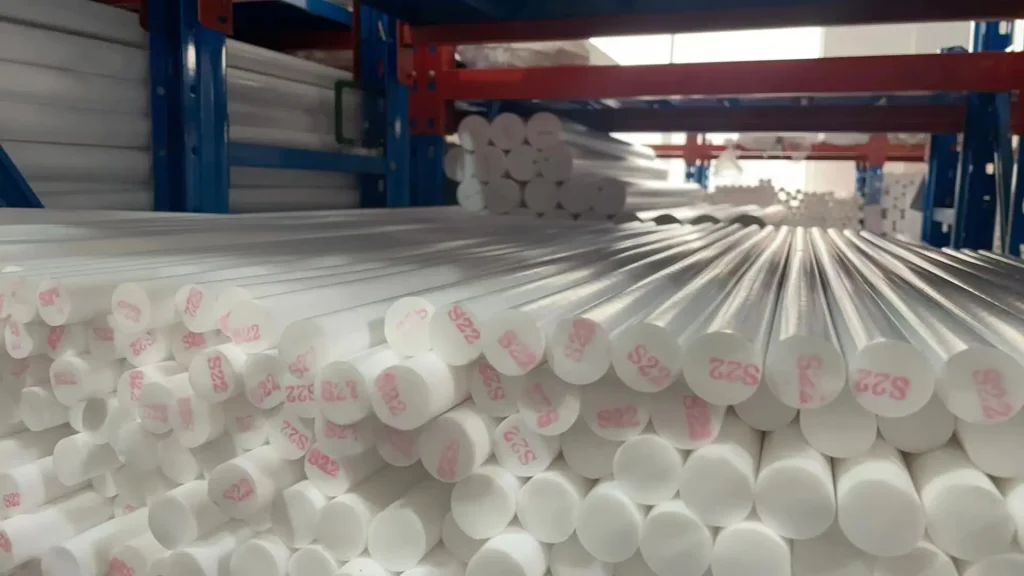
PTFE rods are such amazingly diverse in properties that they can be applied in most demanding industrial applications. They are physical, mechanical, thermal, electrical, and chemical ones.
A. Physical Property:
● Density: about 2.1 2.3 g/cm³
● Color: Normally white although fillers can change the color.
● Water Absorption: It is almost zero; thus it is highly resistant to moisture and suitable to humid or even submerged applications.
B. Mechanical properties:
● Tensile Strength: 20-35 Mpa
● Flexural Strength: Approximately 15 -25 MPa
● Load-Bearing Capability: PTFE has a good level of flexibility, and although unfilled it cannot be used in a high-load application, which it would creep.
C. Thermal Properties:
● Temperature Range: -200°C to +260°C
● Heat Resistance: Structurally and chemically stable at high levels of temperature.
D. Electrical Qualities:
Dielectric Strength: 60100kV/mm ( loose )
Insulation Abilities: Good, low dielectric loss, and high resistivity, applicable as high voltages.
E. Chemical Resistant:
● Acids: Acids do not attack the Inert material even in concentrated form of nitric and sulfuric acids.
● Alkalis: They are stable in re-basic environments.
● Solvents: It is not soluble in organics.
● Non-responsive characteristics: Nonreactive to majority of chemicals making it last long.
All these properties mix to give a resultant material that is versatile and reliable when operating at extreme conditions.
Manufacturing and Types of PTFE Rods
The production of PTFE rods is carried out by two primary procedures: extrusion as well as compression molding.
● Compression Molding: This is where a PTFE powder is put into a mold and then heat and pressure is applied. The produced rods are compact, homogenous and applied in situations where highest purity and less porosity is needed.
● Extrusion: PTFE resin can be extrusion molded to form long rods. It is more economical to make continuous lengths, but because the stamping process does not use as much pressure as compression molding it may have slightly poorer density than compression molded rods.
There Are Various Types of PTFE Rods:
● Virgin PTFE Rods: They are based on 100 percent pure PTFE resin, which means that they are fully resistant to chemicals and heat.
● Filled PTFE Rods: Improved with other materials such as glass fiber, carbon or graphite or bronzed to increase wear resistance, strength or conductivity.
● Skived PTFE Rods: Other Conduits; Thin sections of PTFE block removed to make rods or sheets and are usually used in seals and gaskets.
Dimensions and Tolerances:
The PTFE rods are in the form of regular rods in different diameters of a few millimeters to several inches long with the standard length of 1000mm or more. Tolerance is not the same for all methods of manufacture but precision cut rods can be produced to meet special applications.
PTFE rods come in a wide range of types and sizes including the ability to be custom-made to fit the precise requirements of numerous industrial processes.
Advantages of PTFE Rod
PTFE rods are very popular due to their inimitable array of positive characteristics:
- Enhanced Chemical Resistance: PTFE is almost immune to reaction with most industrial chemicals like corrosive acids and bases and this translates into reliability in harsh environments over a long life.
- Low Coefficient of Friction: It has smooth and non-stick surface and hence, there is less friction and less wear which makes it best suited to be used in moving parts such as bearings, sliders and seals of automotive industry.
- Large Temperature until High Thermal Stability: PTFE can work within a range of -200 to +260 °C, and can be used in large ranges of temperatures, with all the chemical and physical properties still making up.
- Non-Stick and Self-Lubricating: There is no need of adding lubrication to PTFE, which is resistant to adhesion.
- Electrical Insulation Properties: PTFE has excellent dielectric properties and resistivity hence finds applications in high voltage, cables, and insulators.
- Longevity, Durability: PTFE is now resistant to aging, UV exposures and poor environmental conditions making it have a long life span even in a hostile environment.
The qualities qualify PTFE rods to be a default solution in mission-critical applications that require durability, cleanliness, and stress resistance.
Limitations of PTFE Rod
Although the use of PTFE rods are incredibly beneficial due to the many advantages they bring to an industry, not everything is rosy. These limitations are very important in deciding their applicability towards certain applications:
1. Creep And cold Flow:
Perhaps the biggest known problem with PTFE is that it tends to creep under sustained mechanical stress, particularly at high temperatures; that is, under sustained load, it gradually, continuously suffers a deformation. This may cause dimensional instability with time, and so PTFE is a less acceptable structural material, where moisture content may cause a variation in tolerances or an inability to maintain repeated load-bearing duties.
2. Low Wear Resistance (In The Virgin Condition):
Although chemically inert and thermally stable, virgin or unfilled PTFE has insufficient abrasion and wear resistance to make it suitable in the rigorous mechanical applications. It may wear out rapidly in an environment that involves friction and repetitive motion. Towards this, its durability and hardness on surface is significantly enhanced by the use of filled PTFE surfaces- e.g. by reinforcing with glass fiber, carbon, or bronze- to dramatic levels.
3. High Cost:
PTFE is much more costly than typical engineering plastics such as nylon, HDPE (High-Density Polyethylene) or POM (Polyoxymethylene/Delrin). This is a factor which may be restrictive on cost conscious projects or large volume production unless it is a particular requirement of its properties.
4. Machining Considerations:
PTFE being slippery and soft, presents a problem when it is being machined. It may be distorted using pressure, which results in the inaccuracies of the final product. Machinists also have to apply sharp tools, low feed rates and reign in cutting speeds when heavy precision is required. Some warping or cold flow may still be experienced even after that, and it may be necessary to handle carefully and to stabilize by post-machining.
Applications of PTFE Rod Across Industries
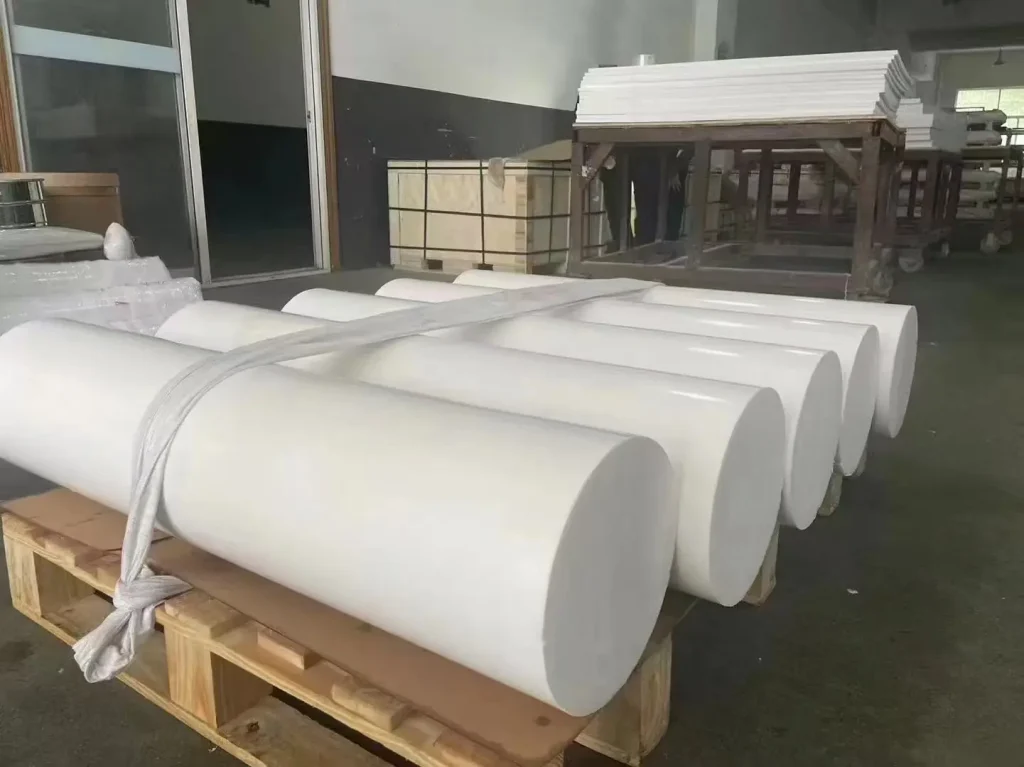
PTFE rods installed in many different industries are attributable to its use to perform tough environments. Some of the major areas and common applications are shown below:
A. Chemical Processing Industry
The chemical processing industry uses PTFE rods because of their matchless resistance to chemicals. They find extensive application in manufacture of gaskets and seals which have to resist repeated contact with aggressive acids, solvents and corrosive gases without either deteriorating or reacting.
PTFE is also widely used as valve seat and lining material in reactors, pumps and pipelines providing good sealing in applications that traditional metal and rubber materials would rapidly fail.
B. Food and Beverage Business
Due to its non-stick ability and approval by FDA in grades, PTFE is excellent in food and beverage industry because hygiene and free-of-contaminants operations are very crucial. PTFE rod is machined into parts such as non-stick rollers, blades and guides which are found in food processing equipment.
They are also resistant to moisture, fats, and cleaning chemicals, which exactly matches the expectations of put in use in the mixer parts and other components that need frequent sanitization. Besides the fact that these components are durable, they enhance the purity of food products because they are resistant to bacterial growth and chemical leaching.
C. Electrical and electronics
PTFE is therefore very instrumental in electrical and electronic applications due to its high dielectric strength and thermal stability. Dielectric insulators and barriers In a high-voltage system PTFE rods are commonly employed as a means of ensuring safety and signal integrity.
Ptfe Cable insulation has special value in sensitive electronic applications and telecommunications applications, as it is resistant to short circuits, capable of withstanding high heat, and does not degrade in the environment.
D. Mechanical Engineering
PTFE rods are appreciated in the mechanical engineering process due to the low coefficient of friction and self-lubricating property. They are commonly made in bushings and bearings that have a smooth running effect without any further application of lubricants even in dry dusty weather conditions or where corrosiveness is concerned.
Wear strips, piston rings, and slide plates made of PTFE are also manufactured but they have to withstand continual mechanical load whilst being able to retain long term performance as well as keep maintenance requirements to a minimum.
E. Pharmaceutical and Medical
The chemical inertia and biocompatibility of PTFE imply that it is used in medical devices and pharmaceutical products (among others). The PTFE rods are converted into parts (implantable part, parts of diagnostic devices, and surgical instruments) used in this sector.
They also are employed in producing tubing, valve seats and fluid-handling systems which are required to be sterile and non-reactive. PTFE resistance towards repeated sterilization procedures and its harmless nature make it safe on patients and reliable in products.
F. Automotive and Aerospace
PTFE rods are also utilized in high-performance industries such as aerospace or automobile industries to manufacture parts which will be expected to operate in harsh conditions. PTFE sealing rings and gaskets can withstand a very large temperature range and different exposure to oils, fuels, and other analogous harsh chemical ingresses.
They are also utilized to make light of wears and resistant parts made of PTFE that can be used to lower the friction and thus fuel efficiency in both commercial and military aerospace industries, which is of utmost importance to vehicle performance and durability.
PTFE Rod vs. Other Materials
PTFE vs. Nylon
The coefficient of friction of PTFE is much lower than that of Nylon and thus it is suitable to use in a sliding application. It is also much chemically inert, cracking almost any corrosive material. However, Nylon has superior strengths in tensile and impact resistance, but can be used in structures, unfortunately, it does not work well in either high heat or in caustic environments, compared to PTFE.
PTFE vs. POM ( Delrin )
Delrin is more appropriate in high-wear applications owing to its better resistance to abrasion and PTFE better excels in chemical resistance and stability in high temperatures. They are both simple to machine, though PTFE has to be handled more sensitively since it is softer. Delrin is frequently selected when mechanical parts are required; in environments with corrosive or high temperature conditions, PTFE is preferred.
PTFE vs. PEEK
PEEK is stronger mechanically, has a higher load-bearing capacity, and better known as being dimensionally stable although at a much higher price compared with PTFE. Both are thermally stable however PTFE is the choice of this kind of environment because it is less chemically reactive. In cases where strength and durability are vital, PEEK comes in handy.
| Property | PTFE | Nylon | POM (Delrin) | PEEK |
| Temp. Resistance | High | Moderate | Moderate | Very High |
| Chemical Resistance | Excellent | Fair | Good | Excellent |
| Friction | Very Low | Moderate | Low | Low |
| Cost | High | Low | Moderate | Very High |
PTFE stands out where chemical resistance and thermal stability are key.
Machining and Handling PTFE Rod
Operation The PTFE in the form of rods is a soft material that distorts easily under pressure. It is very necessary to take extra precautions when machining them.
1. Snipping and drilling:
Work with sharp and carbide tipped tools.
Continue maintaining low speeds of the cutting process to minimize the heat.
Fix the piece of work to prevent movements.
2. Turning and Milling :
Employ hard accessories and cutting tools.
The level of the feed rates must be managed modestly to reduce the flex of the material.
Do not use too much pressure that can result in dimensional errors.
3. Precautions:
PTFE produces smooth slippery shaving, keep work areas clean.
Coolants should be used when the temperature needs to be decreased.
4. Storage:
Keep cool and dry and keep out of direct sunlight.
Do not load the PTFE rods with objects that are too heavy otherwise the rods will get deformed.
Dressing and machining also aids in providing accurate dependable pieces.
Compliances and Certifications
PTFE made in regulated industries has to correspond to certain certifications:
● FDA Approval: Virgin PTFE is approved by FDA on food and beverage processing machineries.
● ASTM and ISO Standards: Check dimensional accurateness, purity and mechanical properties.
● RoHS Compliance: absence of restricted hazardous substances hence being environmental friendly.
● Electrical Safety Certifications: Measured dielectric performance to be used in an electrical and electronic system.
The certifications make PTFE rods safe, of high quality, and fit to be used worldwide.
How to Choose the Right PTFE Rod?
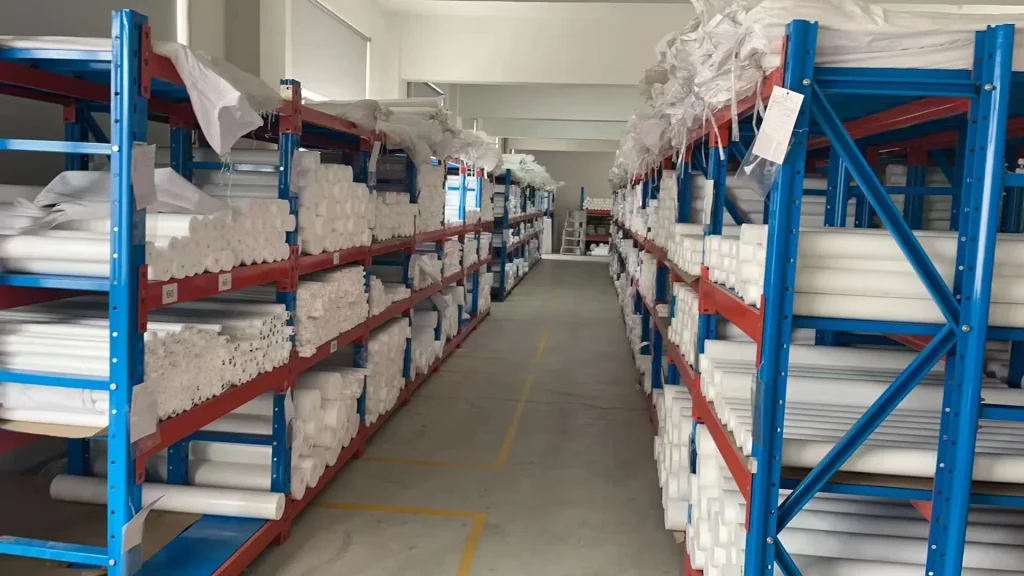
The best PTFE rod to be used should be selected to guarantee an outstanding performance, durability, and safety in a given application. PTFE rods are offered in grades, size, and formulations to suit the various industrial needs. It can be a well-informed decision once you learn a few essential factors of weight loss.
1. Key Considerations
Size and Tolerance: You need to be more accurate when selecting the diameter and length of the rod to your equipment or design intention. Close tolerances are essential; they are important in seal or bushing applications or some parts which demand a precise fit.
Filler Type: Virgin PTFE can make an exceptional choice in purity and chemical resistance but filled PTFE rods (i.e. with glass fiber, carbon or bronze) can provide greater strength, wear reduction, and dimensional stability. Such improvements qualify them to be used in mechanical and structural purposes.
Temperature Rating: It is always important to make sure that the maximum operating temperature of the material is known. Pure PTFE can normally withstand temperatures up to 260°C (500°F), although some manufacturing processes cause variations. Ensure that the rod that you choose fits into the thermal environment of your system.
2.Vendor Selection Words of Wisdom
Reputation and Reliability: Select suppliers with a proven history and customer satisfaction with respect to the supply of high performance products in PTFE. A good vendor means that there is consistency in quality of materials and technical support.
Technical Description: Seek highly detailed datasheets incorporating mechanical, thermal and chemical characteristics. This can allow you to draw a comparison of grades and get the most appropriate rod that fits your application.
Certifications: Certifications to specific use: Depending on the application, such as food processing, medical, or electronics, the rods may need to be certified to some specific standard, such as FDA, RoHS directive, or ISO standards. These qualifications provide safety, regulation, and integrity in terms of performance.
3. Cost Factors
Virgin vs. Filled PTFE Veteran PTFE rods are usually more costly, since they tend to be purer, have extraordinary chemical resurgence, and low friction properties. They are usually employed in critical establishments such as pharmaceuticals or electronics.
Filled PTFE rods can be a cost effective alternative to pure PTFE rods where the purity of the rods is not a factor in the mechanical or industrial application. All these variants continue to offer high performance with a decreased wear and enhanced strength.
In the end it all comes down to cost performance and reliability as far as choosing the right PTFE rod is concerned. A well-selected rod does not only increase the effectiveness of operations but also increases the service life of parts much more-with a minimum number of maintenance operations and downtime.
Bottom Line
Modern engineering would be rather incomplete without PTFE rods as they offer the unique balancing of outstanding chemical resistance, thermal stability, low friction and electrical insulating capabilities. PTFE has also been able to deliver not only in food processing equipment but also in high voltage electronics and aerospace systems subjects to harsh conditions.
Although the solution has its drawbacks, like creep and increased implied cost, this can be overcome through choosing the appropriate filler and the appropriate design strategies. By knowing more about PTFE rods in regards to their properties, certifications, and machining processes, engineers get an informed decision in their choice of material in order to work with safer and more efficient systems.
There is hardly any industry today to have not used PTFE rods in its long-term performance and versatility.


