
Introduction
Before nylon, polypropylene, or any of the current engineering plastics, there was Baquelita. It arrived in 1907. It was the only synthetic polymer engineers had at the time. That monopoly was not permanent, but the material was.
Enter a motor winding shop now. The same slot insulators made of Baquelita will be sitting where they have been since the 1940s.
That’s not nostalgia. That’s simply delivering on promise. The material has had remarkable results. And that, in particular, in areas where numerous contemporary replacements have silently failed.
Here, this article will discuss exactly what Baquelita is. We’ll go in depth on applications, properties, advantages, and so on. Note that Baquelita is the same as Bakelite, as it is commonly spelled.
Here’s where this piece gets more intriguing and invaluable. We’ll tell you what it isn’t and where/when you shouldn’t even consider it. In addition, we’ll compare past and present alternatives. You can’t find it better elsewhere. Stay tuned.
The Birth of Synthetic Polymers: Why Baquelita Changed Material Science?
Leo Baekeland was trying to make a synthetic shellac replacement. In 1907, he produced a phenol formaldehyde condensate. The result was not just remarkable, it had never been seen or heard. It was rigid and didn’t soften when heated. As long as it was well cured, it was permanent.
Before Baquelita, electrical insulation came from natural materials. Hard rubber degraded with UV exposure.
To be honest, Mica was effective. But it had one challenge. It was quite difficult to machine. On its own part, Shellac paper was unpredictable with its moisture absorption. All these materials are naturally occurring. They were not engineered. Manufacturers hoped they will come through, but it was not to be so.
Baquelita changed all that. For the first time, engineers could tweak a material’s properties to their taste. For instance, by varying the resin ratio, cure cycle, and reinforcement type, you can change the outcome.
For a reinforcing material like Cotton cloth, it had good impact resistance and easy machining. Paper had the advantage of tighter tolerances and cleaner electrical surfaces.
By the 1930s, Bakelite had gained global recognition and use. Quickly, telecoms manufacturers adopted its use in telephone handsets. Other uses like distributor caps, circuit breakers, and gear blanks became common.
Today, the effect of Bakeland’s original formulation has trickled down. Infact, it has metamorphosed to other forms. For example, PFCC201 cotton cloth laminate and Grade C NEMA laminate are direct descendants.
Thermoset Identity: What Makes Baquelita Structurally Unique?
1) Irreversible Crosslinked Network
During curing, phenol reacts with formaldehyde to form multidirectional covalent bonds. The result is a continuous molecular network with no mobile chain segments and no melting point.
You rarely find this quality in plastics used in electrical engineering. This is down to the unique molecular architecture of Bakelite.
The practical result is dimensional permanence under thermal cycling. This is unlike most thermoplastics that expand and contract with repeated cycles. Some even swell and warp and are not recommended for serious engineering construction.
2) Brittle but Stable: Understanding Its Mechanical Personality
Baquelita is brittle. Place a piece of unfilled phenolic rod on a concrete surface, and it may crack. This is to be expected in a highly crosslinked network. It also has low plastic deformation ability before failure. Without much straining, engineers get around its design.
With pressure, however, the tale is different. In a cotton-reinforced laminate, compressive strength is 200 MPA or above. It does not creep under long-term load as nylon or acetal will do.
PFCC201 grade flexural strength at room temperature is 100 to 124 Mpa. It retains over 50 percent of that value at 150°C.
Don’t be confused. These values do not in any way suggest weakness. They are expected of materials that are brittle but stable.
3) Electrical Insulation by Molecular Design
The dielectric performance of Bakelite is hinged on one simple fact. It’s phenolic backbone is an aromatic ring that doesn’t conduct electrons.
The dense crosslinked network completely prevents ion mobility. Therefore, moisture can’t penetrate and weaken it the way it does in many alternatives.
Little wonder, the material has exceptional values for Dielectric strength and insulation resistance. (Dielectric strength >0.82 kV/mm in oil at 90°C. Insulation resistance > 10⁶ Ω after 24 hours of immersion.
Arc resistance is equally important. When an arc strikes the surface, the material carbonizes. It doesn’t track, and no conductive path is formed.
Baquelita in High-Risk Environments
1) High-Temperature Electrical Zones
Appliances like transformer barriers, motor windings, and switchboard terminals have high temperature requirements. Only specific materials can handle this requirement.
Thankfully, Baquelita is an IEC grade E material. It has a thermal index of 120°C.
This meets the requirements of these high-temperature electrical devices. It runs continuously at this temperature. Most thermoplastics would degrade at even lower temperatures.
2) Oil-Exposed Mechanical Systems
The cured phenolic resin matrix has low affinity for petroleum-based fluids. Phenolic bushings have dimensional stability when immersed in oils like gear oils. Unlike some other polymer materials, it doesn’t swell or soften to this exposure.
This stability is also applicable in dry conditions. This increases the versatility of Bakelite as it can be used suitably in many conditions.
3) Friction and Wear Interfaces
When cotton is used as reinforcement, it brings an added advantage for sliding parts. This is because of its low friction coefficient. This is notable because in these settings, oil or water lubrication is absent.
The cotton weave naturally lubricates the wear surfaces. One common example is PFCC201 grade material.
In settings and designs where gear blanks run against steel pinions, friction must be handled well. This is commonly found in textile machinery and timing drives.
Graphite-filled grades extend this further. It reduces the friction coefficient and improves performance in cases of intermittent lubrication.
4) Flame-Sensitive Installations
Standard phenolic laminates comply with IEC 60893 specifications on thermal stability. Materials with such requirements self-extinguishing within 10 sec after the ignition source is removed.
This quality is very useful in enclosed panels and motor housings. In these appliances fire spread is prevented from spreading from the source to delicate components.
Industrial Forms of Baquelita You Should Know
There are several forms of Baquelita you should know. This will make you less confused because many authors use these forms interchangeably. Also, you can predict the behaviour of the different materials based on your knowledge of Bakelite.
1) Sheets and Laminates
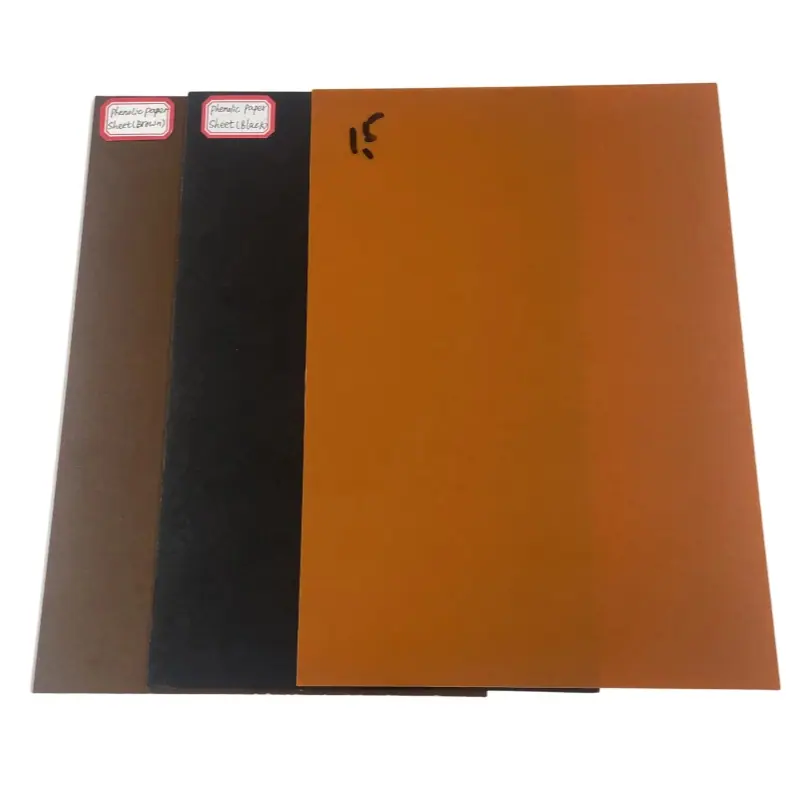
This is the most common industrial form. The sheets range from 0.4 mm to 100 mm thickness in standard panel sizes of 1020 x 1220 mm and 1020 x 2040 mm.
The sheets are usually precursors for other forms like rods and tubes. They can be further processed into machined insulators, slot wedges, terminal boards, and structural spacers.
Large sheets can be further cut into desired sizes as the need arises. They can also be processed into other forms mentioned below.
2) Rods, Tubes, and Molded Components
Beyond flat sheets, bakelite can be transformed and shaped into rods, tubes, and precision-molded components. These varieties are indispensable across heavy industry.
Rods have exceptional compressive strength. They are most used for machined parts and insulators. On the other hand, tubes provide chemically resistant conduits for electrical and fluid systems.
Molded components are formed under intense heat and pressure. They deliver complex, tight-tolerance shapes that metals alone cannot achieve.
3) Fabric Reinforced vs Paper-Based Grades
The reinforcement inside the sheet is what determines its quality and use. Selecting the wrong grade is probably the most common error by inexperienced manufacturers.
When friction and impact resistance pose a challenge, cotton cloth are good options. Gears and bearings are common applications where these cloth grades overcome friction. Common cotton grades include PFCC201 and NEMA Grade C.
Paper-based grades like PFCP201 have their own peculiar benefits. They enable tighter tolerances and cleaner electrical surfaces.
How Baquelita Behaves During Machining and Fabrication?
With carbide cutting tools, phenolic laminates can be cut cleanly. Also, processes like CNC routing, drilling, turning, and milling can easily be achieved with standard parameters.
Now, there are two very important determinants of the functionality of the material. These are the feed rate on breakthrough cuts and the backing material under drill exit points. These prevent delamination at the edge.
Abrasive filler content wears cutting edges fast. For more sample quantities, carbide tools are recommended.
Ground phenolic surfaces can achieve flatness. The material doesn’t spring back after cutting.
Phenolic dust needs extraction at the cutting point. It’s a nuisance dust, not a silica hazard. But respiratory protection remain good practice.
Performance Trade-Offs Engineers Often Overlook
Strength vs Toughness
Bakelite’s rigid crosslinked network is responsible for its high compressive strength.
It works best when loading is controlled. However, with repeated and heavy shocks, the material may cave in.
Cost vs Long-Term Stability
Per Kilogram cost of Bakelite is far less than FR4 and most engineering-grade thermoplastics. But that comparison misses the more important number. The overall cost over service is life is even far less.
For example, a phenolic bushing specified correctly in a gear system can run for 20 years without replacement. Its nylon equivalent, under the same thermal cycling and load, may need replacement every 3 to 5 years. So, always consider long term cost when doing your math.
When Baquelita Is NOT the Right Material?
Baquelita is not always the best choice even with its excellent properties. We’ll mention a few here.
When operating at temperatures above 130°C, consider alternatives with better thermal stability. In addition, in cases of impact dominated applications, they don’t thrive well. Furthermore, conditions requiring UL94 V0 flame rating may benefit more from glass epoxy.
In general, consider alternatives in these conditions as well as in environments that require tight moisture control over long periods. Knowing where a material stops being useful is as important as knowing where it starts.
Baquelita vs Modern Engineering Plastics
| Property | Baquelita PFCC | Nylon PA66 | Epoxy FR4 | Acetal POM |
| Max continuous temp | 120°C | 80 to 100°C | 130 to 155°C | 90 to 100°C |
| Compressive strength | 200+ MPa | 80 to 100 MPa | 200 to 300 MPa | 110 to 130 MPa |
| Impact resistance | Low | High | Moderate | High |
| Dielectric strength | 0.82+ kV/mm | 15 to 17 kV/mm | 18 to 22 kV/mm | 20 to 25 kV/mm |
| Moisture absorption | Low (0.5 to 1%) | High (1 to 2.5%) | Very low (0.1%) | Low (0.2%) |
| Machinability | Good | Good | Moderate | Excellent |
| Relative cost | Low | Low to medium | Medium to high | Medium to high |
| Flame resistance | Self extinguishing | Poor | V0 grades available | Poor |
1) Baquelita vs Nylon (PA)
Nylon absorbs between 1% and 2.5% moisture of its weight. This can lead to dimensional changes over time. Furthermore, moisture causes significant mechanical degradation, especially in humid conditions.
On the converse, Bakelite stays below 1% absorption and consequently maintains it dimensions. On thermal performance as well, there is a considerable difference.
For example, at temperatures above 80 to 100°C, Nylon-based materials soften. Bakelite, on the other hand, can tolerate up to 120°C with continuous service.
So, in summary, Bakelite comes tops in terms of heat, humidity, and electrical insulation.
2) Baquelita vs Epoxy Laminates (FR4 / G10)
For insulating materials. the dielectric values are so important. FR4 reaches 18 to 22 kV/mm against bakelite’s 0.82 kV/mm. This makes FR4 the clear choice for high voltage and high frequency circuits.
Compressive strength is where they have similarities, as both exceed 200 MPa. However, price is a big difference. Bakelite is generally cheaper. It is better suited for applications that do not have high demands.
3) Baquelita vs POM (Acetal)
Acetal’s biggest advantage over Bakelite is that it is easy to machine. It has better impact resistance. Also, it generally provides smooth operation. As a result, it works especially well in precision mechanical parts such as gears and bearing surfaces.
The drawback, however, is that acetal has a lower thermal limit of about 100°C and does not resist flames. Bakelite, in contrast, is self-extinguishing. It can operate continuously at temperatures up to 120°C.
Why Baquelita Remains Relevant in 2026?
Going down history lane, many materials gave the feeling of “the next big thing” at inception. However, they quickly faded out for lack of promise. Thankfully, this is not the narrative for Bakelite.
Since its discovery, it has found tremendous use till date. This is majorly down to its combination of properties.
Sustainability is also worthy of mention. A material that lasts longer needs less maintenance or replacement. This translates to less manufacturing energy, material throughput, and disposal over the life of a machine.
Common Misconceptions About Baquelita
1) Is it outdated?
We’ve established that Bakelite is still relevant today. It remains in active specification across electrical, industrial, and mechanical applications globally. There is in fact hope for longevity due to the different forms it exists in that makes it suit different purposes. In one word, this is versatility.
2) Is Baquelita the same as phenolic laminate?
Not exactly. Bakelite is a type of phenolic resin. Phenolic laminate is that resin combined with a reinforcing substrate, typically paper or woven fabric.
So phenolic resin is a broader class of polymers to which Bakelite belongs. The phenolic framework is the common decimal. Not all phenolic resins are Bakelite, but every Bakelite is a phenolic resin.
3) Is it brittle and weak?
Yes, it is brittle under impact, however, it is not weak. Compressive strength exceeding 200 MPa places it above nylon and acetal in load bearing applications.
The confusion comes from treating low impact resistance as a general indicator of poor mechanical performance. It isn’t.
FAQs
1) Is Baquelita the same as phenolic resin?
It is a phenol formaldehyde thermoset. That places it within the phenolic resin family. Technically, phenolic resin is the broader category.
2) Can Baquelita withstand high temperatures continuously?
Standard grades are rated for continuous operation at 120°C under IEC thermal classification E.
The material holds its properties right up to that temperature. It doesn’t soften gradually the way thermoplastics do. Above the rating, degradation begins relatively abruptly.
3) Does Baquelita absorb moisture over time?
A 2 mm sheet absorbs under 229 mg after 24 hours of water immersion. Insulation resistance stays above 10 to the power of 6 ohms under those conditions.
For permanently submerged or continuously humid applications, moisture behavior should be factored into the specification. It is low, but it is not zero.
Final Thoughts
So, the story about Bakelite is not history now. It is relevant as it was in the past when it changed the narrative. One thing has made this possible.
The properties that made it useful in applications are the same properties specifiers relied on today. You’ll agree these are key properties of any insulating material.
Bakelite is not always the best option. Use this guide to know when it is the best fit. Sometimes, the best option may not be about performance. It can be cost effectiveness. However, for most moderate to high demand appliances, Bakelite does the job.


